


How Early Relationships Shape Our Inner World — and How Therapy Can Help Heal It
Most of us don’t remember our first years of life. And yet, many of us live with their emotional imprint every day.
Why do some people expect comfort when they’re distressed, while others withdraw?
Why do certain emotions feel overwhelming or confusing?
Why does closeness sometimes feel soothing—and sometimes threatening?
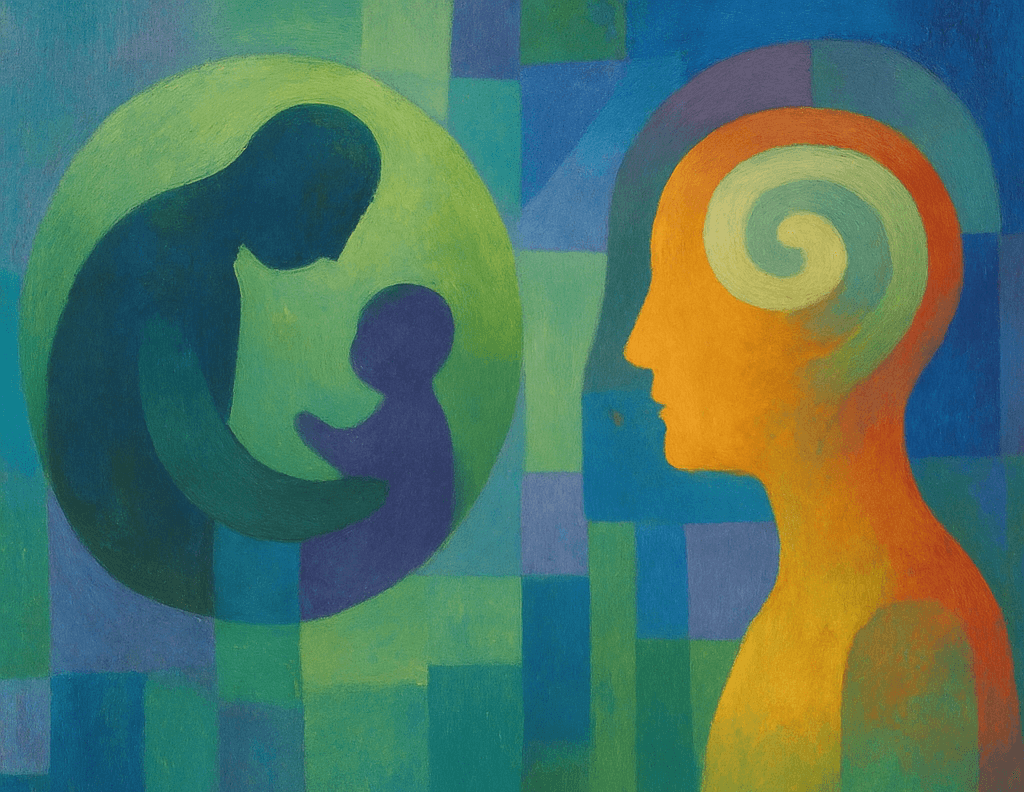
Psychodynamic psychotherapy starts with a simple but profound idea: our earliest relationships quietly shape how we experience ourselves, others, and the world. Not in a fixed or deterministic way—but in patterns that can later be understood, softened, and changed.
Let’s explore how this happens and how therapy works with these early patterns.
From the Very Beginning: Learning What to Expect From the World
From the first weeks of life, infants are already oriented toward relationships. Babies recognise familiar caregivers early on—not just because they provide food, but because of touch, proximity, tone of voice, facial expressions, and emotional presence.
When a caregiver responds consistently—picking up a crying baby, soothing fear, responding to hunger—the infant slowly develops an inner expectation that can be summed up as:
“When something feels bad, someone will help.”
This expectation becomes an internal working model—a kind of emotional blueprint for how relationships work. Over time, this model expands beyond the caregiver to the wider world.
If care is mostly reliable, the world begins to feel predictable and safe.
If care is absent, inconsistent, or overwhelming, the world may feel unreliable—or one must learn to rely only on oneself.
Importantly, at this early stage, infants don’t experience themselves as clearly separate from their caregivers. Their emotional world is shared. How they experience their caregiver becomes how they experience themselves.
Learning Feelings: How Caregivers Teach Us What Emotions Mean
Babies are born with powerful feelings—but not with an understanding of them. They rely on caregivers to help make sense of their inner states.
Caregivers do this in subtle ways:
- Facial expressions
- Tone of voice
- Body posture
- Emotional “yes” or “no” cues
A calm, attuned caregiver helps an infant learn:
- This feeling can be tolerated
- This feeling makes sense
- This feeling will pass
When a caregiver mirrors a baby’s emotion (“You’re upset”) and holds it without being overwhelmed, the baby learns that feelings can be shared, contained, and understood.
Over time, this allows something crucial to develop: the ability to hold mixed feelings at once—love and anger, desire and disappointment. This capacity is foundational for emotional maturity and healthy relationships.
Mentalising: Learning to Understand Yourself and Others
Through repeated experiences of being emotionally understood, infants slowly develop mentalising—the ability to reflect on thoughts, feelings, intentions, and motivations in themselves and others.
When caregivers are emotionally attuned, children learn:
- My feelings are real
- They have meaning
- I can think about them rather than just act on them
When caregiving is absent, dismissive, unpredictable, or frightening, children may adapt in other ways:
- Disconnecting from feelings
- Becoming hyper-focused on others’ moods
- Living “from the outside in,” rather than the inside out
These strategies are not failures—they are adaptations. They may once have been necessary for survival. But later in life, they can interfere with intimacy, self-understanding, and emotional regulation.
If these patterns resonate with your own experience, know that you deserve a space to be truly seen and heard. I offer a compassionate environment to explore your inner world safely. I invite you to book a session with me and begin the path to understanding.
Play: Where the Inner World Comes to Life
Play is not just entertainment—it is how children explore identity, emotions, and relationships.
Through play, children rehearse:
- Attachment and separation
- Caregiver roles
- Desire, frustration, and repair
But play requires safety.
When caregivers are emotionally available, children feel free to experiment, imagine, and express themselves. When caregivers are distant, frightening, or disengaged, play often becomes restricted—or disappears altogether.
In psychodynamic terms, play reveals how a child experiences relationships internally.
What This Means for Psychodynamic Psychotherapy
Many adults come to therapy feeling:
- Emotionally overwhelmed or emotionally numb
- Confused by their reactions
- Trapped in recurring relational patterns
- Unable to ask for help—or unable to tolerate needing it
Psychodynamic psychotherapy works with the same processes described above—but in adult form. You can read more about how this process unfolds in our related article on Psychoanalysis as a Lived Emotional Experience.
The therapeutic relationship provides:
- An emotionally attuned presence
- Space to explore feelings safely
- A place where emotions can be named, held, and understood
- Opportunities to reflect rather than react
Over time, therapy helps people:
- Develop greater emotional regulation
- Understand the origins of their patterns
- Internalise the experience of being understood
- Relate to themselves and others with more flexibility and compassion
In other words, therapy doesn’t just offer insight—it helps update old emotional expectations that no longer serve you.
A Final Thought
Your early relationships were not your choice.
Yet by understanding them, you can feel more freedom in the life you choose now.
Psychodynamic psychotherapy does not believe that the past defines the future. It recognises that what once helped you survive may now be ready to change.
And change begins—not by erasing the past—but by finally making sense of it, together.
If you’ve ever wondered why you feel the way you do, or why relationships feel so difficult despite your best intentions, psychodynamic psychotherapy offers a fulfilling, deeply human way of understanding—and healing—those questions.
Your story deserves to be held with care. If you are ready to soften old patterns and find new freedom, book a session with me. Let me support you in creating the emotional reality you want to see.